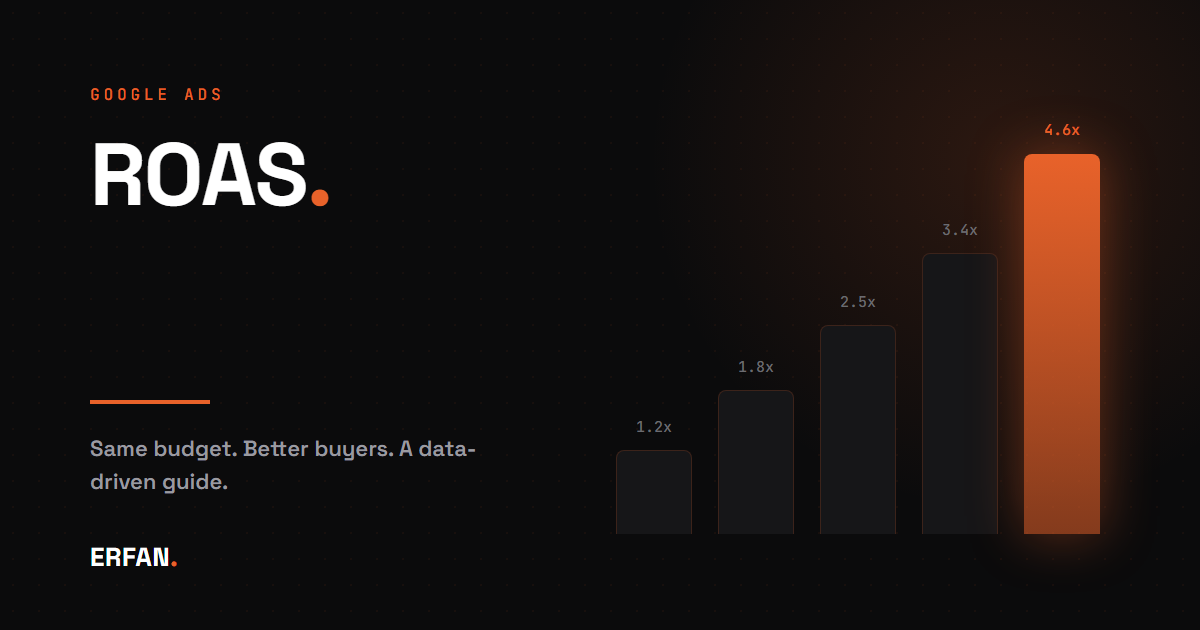
How to Improve Your Google Ads ROAS: A Data-Driven Guide
Learn the proven strategies to increase your Return on Ad Spend on Google Ads — from campaign structure to bidding strategies and landing page optimization.
Erfan Hasanzadeh
April 1, 2026
Every Google Ads campaign lives or dies by one number: ROAS (Return on Ad Spend). After managing over 120 campaigns, I’ve found that most advertisers leave money on the table not because their ads are bad — but because their structure is wrong.
What Is ROAS and Why It Matters
ROAS tells you how much revenue you earn for every dollar spent on ads. A 4x ROAS means $4 in revenue for every $1 spent. Simple on paper, complex in practice.
The challenge is that ROAS is a lagging indicator. By the time you see it drop, you’ve already lost money. The goal is to build systems that catch problems before they compound.
1. Structure Campaigns by Intent, Not by Product
The most common mistake I see is organizing campaigns by product category. This feels logical but it ignores the most important variable: search intent.
Instead, structure campaigns around three intent tiers:
- Top of funnel — informational queries (“what is X”, “how to X”)
- Mid funnel — comparison queries (“X vs Y”, “best X for Y”)
- Bottom funnel — transactional queries (“buy X”, “X price”, “X near me”)
Each tier needs different bids, different ads, and different landing pages.
2. Use Smart Bidding Correctly
Smart bidding (Target ROAS, Target CPA) works — but only after you’ve fed it enough data. The minimum threshold before switching to Target ROAS is 30–50 conversions per month per campaign.
Before you hit that threshold, use Maximize Conversions with a manual CPA cap. Once you cross 30 conversions, gradually introduce Target ROAS, starting 20% below your actual ROAS to avoid an overcorrection.
3. Match Your Landing Page to the Ad
Traffic quality is only half the equation. The other half is what happens after the click. A highly relevant ad sending traffic to a generic homepage will always underperform a mediocre ad sending traffic to a perfectly matched landing page.
Every $1 spent optimizing your landing page is worth more than $5 spent increasing your ad budget.
The checklist I use for every landing page:
- Headline matches the exact keyword or search theme
- Primary CTA is visible without scrolling (above the fold)
- Load time under 2.5 seconds on mobile
- Social proof (reviews, logos, case study) within the first scroll
4. Negative Keywords Are Your Best ROI
Most accounts I audit are wasting 20–35% of their budget on irrelevant queries. Run a search terms report weekly for the first month, then monthly after that.
Build a shared negative keyword list across campaigns for terms like “free”, “DIY”, “jobs”, “course” — whatever is irrelevant to your offer.
Final Thought
ROAS improvement is not about finding a magic bidding strategy. It’s about systematically removing waste and aligning every element — keyword, ad, landing page, offer — with user intent.
If you want a free audit of your current campaigns, get in touch.
Share
Erfan Hasanzadeh
Erfan Hasanzadeh is a digital marketing strategist with 8+ years of experience in Google Ads, Meta Ads, and data-driven growth.
Get a Free Audit