The Marketing Spine: Six Layers to Build Before You Touch AI
Why AI on top of source-less data just gets wrong answers faster, and the six layers every marketing system has to build in order.
Erfan Hasanzadeh
August 23, 2026
Almost every business wants to bring AI into its marketing right now. But on a real system I audited, 3,441 of 3,452 signups had no source recorded. Every funnel number above that was being computed on nothing. AI on top of data like that does exactly one thing: it gives you wrong answers with complete confidence.
This article walks through the layers that make up a marketing system and why their build order cannot be changed. By the end, you will see why the AI layer has to be the last step, not the first.
What is a marketing spine?
A marketing spine is the system that brings customers in and keeps them, built as the load-bearing structure of the business rather than a department bolted onto the side.
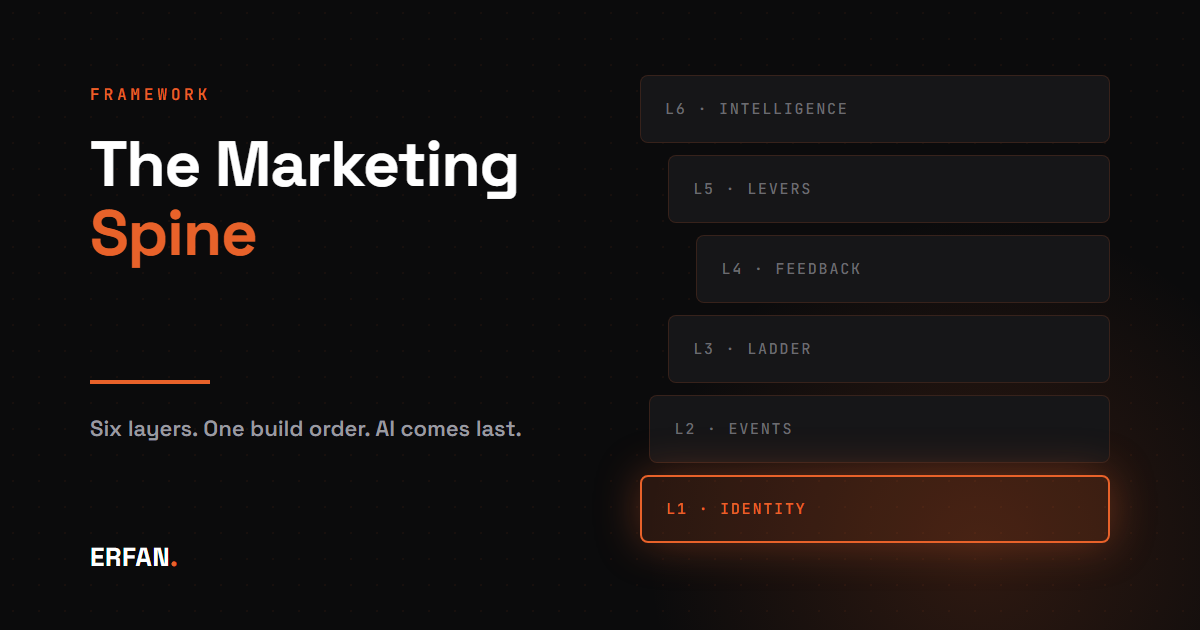
Most businesses treat marketing as a separate unit attached to the main body. The spine idea says the opposite: sales, support and product all read from this structure and write back to it. The spine has six layers: identity, events, the ladder, the feedback loop, levers and intelligence. No layer works without the one below it. That is why building the AI layer before the identity layer only speeds up the production of wrong answers.
What is the customer ladder, and why is your money going to the wrong place?
The customer ladder is the path a stranger takes to become a loyal customer, and every rung has a measurable entry condition.
Every business has this ladder, whether it is written down or not:
Stranger → Lead → Qualified lead → First purchase → Active customer → Loyal customer
Two things trip up most businesses right here:
-
Every rung needs a measurable entry condition. If you cannot say who is standing on which rung, you cannot find the point where customers stop.
-
Almost all of the profit sits on the last rung. But almost all of the ad budget is spent on the first one. The money goes where the profit is not.
What question should you ask before buying any new tool?
Every part of a marketing system does exactly one of three jobs against that ladder:
- Measurement: shows who is on which rung, where they drop off, and which source they came from.
- Movement: a lever that moves someone from one rung to the next.
- Feeding: the flow of data that makes the first two possible.
This is a decision filter, not a description. Before buying any new tool, ask: which of these three jobs does it do, for which rung? If there is no clear answer, the tool solves nothing. It just adds clutter to the system.
What are the six layers of the spine?
The six layers are built from the bottom up, and their order cannot change.
To make each layer concrete, we will follow one example: a clinic that gets its patients from Instagram.
Layer one, identity: why does the ad report never match real sales?
Identity means every person has exactly one record across every channel.
At this layer you know that the person who messaged you on Instagram in March, the one who phoned in May, and the one who booked last week are all the same person.
Without it, those interactions look like three different strangers. You can never see a customer’s whole history, and every number you calculate is calculated on broken data. That is why the ad platform’s report never matches your sales ledger: both systems are counting the same people under different names.
The important part: this layer is usually cheap to build. It is also almost never the thing anyone budgets for.
Layer two, events: if your employee quits tomorrow, what is left of the customer?
An event means everything that happens is written down with its type, date and source.
Everything the customer did should be recorded with a date and a source: saw the ad, asked the price, booked, showed up, paid. Even coming back six months later gets recorded.
Without this layer, you remember the last conversation and nothing before it. The business runs on the memory of whoever happened to be working that day.
Layer three, the ladder: where exactly are customers being lost?
The ladder layer means you can open one screen and say which rung customers have stopped on.
For example: forty people asked the price this month, twelve booked, nine showed up. That means twenty-eight people stopped on exactly one rung. Now you know where the problem is, so you can fix that one point.
Without this layer, you feel busy and you feel like you are losing people, but you cannot say where the drop-off happens. So you cannot fix anything on purpose.
Layer four, the feedback loop: why does the ad algorithm only bring people who click and never buy?
The feedback loop means pulling cost data in from the ad platform and pushing the real value of purchases back out to it.
The ad algorithm delivers exactly what you defined for it. If the only signal you ever send is “someone filled a form”, it will keep finding people who fill forms. Do not forget that clicking and paying are two different crowds.
The fix: tell the ad platform which of the people it sent you actually paid, and how much. Then the platform finds more people like your real buyers, on the same budget. This loop is the most under-used lever in small businesses. With it, the same budget starts bringing in more profitable, higher-value customers. If you run Google Ads, the guide to improving ROAS in Google Ads is a good companion to this layer.
Layer five, levers: why do the best customers get forgotten in busy weeks?
A lever means every rung of the ladder has one automatic action defined for it.
When somebody asks the price and does not book within two days, something should happen by itself. A message, a reminder, an offer, or their name added to a call list.
Without this layer, follow-up depends on how busy your week was. In a busy week, the people worth the most money are exactly the ones who get forgotten.
Layer six, intelligence: when do you actually need AI?
The intelligence layer means the system decides on budget and offers, and it matters only once the audience has grown past what a human can review.
At this stage, the system decides where the budget goes and what offer each person is shown.
Without this layer, you decide. That is completely fine for a long time. This layer is a luxury, not a foundation, and almost no business needs it as early as it thinks.
Why can the build order never change?
Each layer depends on the output of the one below it:
- Events need an identity to attach to.
- The ladder needs events to count.
- The feedback loop needs the ladder to know what value is worth sending back.
- Levers need to know which rung someone is stuck on.
- Intelligence needs all of it, or it is guessing with confidence.
The rule in one line: do not build layer six before layers one and two.
Back to the number from the opening. On the system of a financial services company, we found that 3,441 of 3,452 signups had no source recorded. All the dashboards worked. The charts were beautiful. But every number in the upper layers was computed on nothing. The problem was not the reporting tool or the algorithm. The problem was the lowest layer: identity and source were not being recorded.
A business with one clean customer record and no artificial intelligence is far ahead of a business with artificial intelligence and no customer record. The second one just gets wrong answers faster than anyone can check them.
What are the usual mistakes?
- Buying the top layer first, because it is the one that sounds impressive.
- Adding tools that do not belong to any of these layers.
- Measuring clicks, only because clicks are easy to see.
- Treating the ladder as a report. The ladder is a machine, with a lever on every rung.
Where should you start?
If you take only one action from this article, take this one: check whether the path of your last ten customers is traceable. Do you know where they came from? If the answer is no, your problem is not the absence of AI. Your problem is layer one. The good news: building that layer is usually the cheapest step on the whole path.
Share
Erfan Hasanzadeh
Erfan Hasanzadeh is a digital marketing strategist with 8+ years of experience in Google Ads, Meta Ads, and data-driven growth.
Get a Free Audit